Free Gifts in Quantity Breaks: Why They Make More Money Than Discounts (2026)
Here's the line most stores miss. A discount is paid out of your retail price. A free gift is paid out of your cost price. That single gap is why a gift bolted onto a quantity break tier usually earns more profit per order than cutting the price deeper — while the shopper feels like they got more, not less. This guide shows the math on real numbers, hands you a free gift-vs-discount calculator, and gives you a tier ladder you can copy today.
Quick Answer
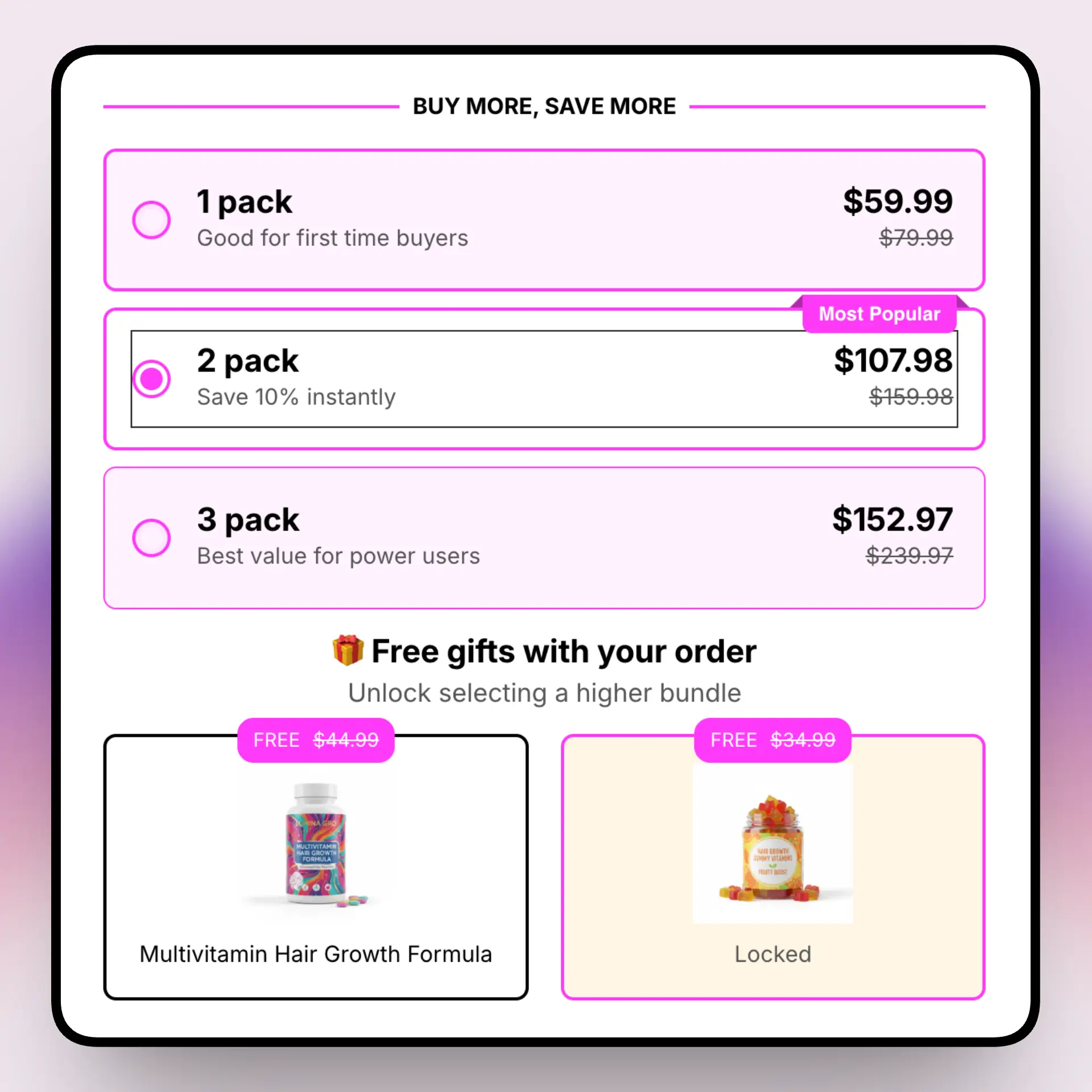
Yes, free gifts raise revenue — because they are cheaper to give than a discount of the same perceived value. A 15% discount on a $75 order costs you $11.25 in real money. A gift that shoppers value at $12 might cost you $4. Same pull, roughly $7 more profit in your pocket, and your full price stays intact. Attach the gift to one tier (not every order), show it on the product page, and keep the gift's cost under about 10% of that tier's order value.
Key Takeaways
- The cost gap is the whole idea. Discounts spend retail dollars. Gifts spend cost dollars.
- Free is not a small price. Demand jumps when a price hits zero, far more than the price drop explains.
- Attach the gift to a tier, one step above your average units per order — never to every order.
- Show it before the add-to-cart button. A gift revealed at checkout can't change what's in the cart.
- Cost rule: your cost for the gift stays under ~10% of the tier's order value, always below the tier's extra profit.
- Ladders beat single gifts. A different gift at each tier gives shoppers a reason to climb one more step.
- Your full price survives. Gifts don't train customers to wait for the next sale. Discounts do.
Most merchants think about quantity price breaks in one dimension: how deep should the discount go?
That's the expensive question. There's a cheaper one hiding next to it.
What if the reward wasn't a smaller price, but an extra thing in the box?
We build quantity break, bundle, and free gift tools at Oxify, so we watch merchants test both sides of this every week. (For context: Oxify is a paid Shopify app — $14.99/month after a 14-day free trial, rated 4.9★ — and gift-with-purchase tiers sit in that same single plan rather than a higher tier.) The pattern is consistent enough to write down — and the reason isn't psychology. It's accounting.
New to tiered pricing? Start with what quantity breaks are, then come back. This guide assumes you already run some form of quantity break pricing — volume discounts, bulk discounts, a buy-more-save-more table — and is about what to put inside those tiers.
The Cost Gap: Why a Gift Is Cheaper Than a Discount
Two offers. Same product. Same shopper. Watch what happens to the money.
Take a $25 product that costs you $15 all-in (product, shipping, packing, payment fees). That's $10 of true profit per unit, a 40% margin. Your tier asks people to buy 3.
| Option A: 15% off the 3-pack | Option B: 3-pack + free gift | |
|---|---|---|
| Shopper pays | $63.75 | $75.00 |
| Your product cost | $45.00 | $45.00 |
| Cost of the reward | $11.25 (the discount) | $4.00 (the gift, at cost) |
| Profit on the order | $18.75 | $26.00 |
| What the shopper feels they got | $11.25 saved | A $12 item, free |
Read the last two rows together. The shopper's perceived reward is slightly bigger in Option B. Your cost is 64% smaller. The order earns $7.25 more.
Nothing clever happened here. It's just where each reward gets paid from:
- A discount is subtracted from your retail price. You lose full-value dollars.
- A gift is subtracted from your cost of goods. You lose wholesale dollars, but the shopper counts it at retail.
Your markup does the work for you. A brand with a 3× markup gives away $12 of felt value for $4 of real money, every single time.
The one-line rule
The higher your markup, the more a free gift beats a discount. If you sell at 3× cost or more (beauty, supplements, accessories, apparel), gifts are almost always the better lever. If your markup is thin (electronics, resale, low-margin commodities), a modest discount is safer.
There's a second, slower benefit that never shows up on one order: your price stays whole. Discount your product often enough and you teach people its "real" price is the sale price. Gifts don't do that. The list price never moves — it just comes with something extra this month. That's the same reason we warn against deep tiers in do quantity breaks hurt profit.
Why "Free" Hits Harder Than "Cheaper"
Here's the part that isn't accounting.
Zero behaves differently from every other price. In the research paper Zero as a Special Price, Shampanier, Mazar and Ariely ran experiments where a price dropped by a few cents — ordinary at first, then all the way to free. Demand didn't step up. It jumped. People treated free as a different category, not a smaller number.
What that means on your product page:
- "Save $12" is a calculation. The shopper has to weigh it.
- "Free travel size, yours at 3 items" is a thing. No math required.
- A gift you can see beats a percentage you have to work out. Show the photo.
Two more forces are quietly pulling the same direction:
- Loss aversion. Once a shopper has decided the gift is theirs, dropping back to 2 units feels like giving something up. That's a stronger motivator than saving a few dollars.
- The decoy effect. Adding a gift to your middle or top tier makes that tier the obvious pick. It's the same anchoring behind three-tier pricing tables — The Decision Lab explains the mechanism if you want the theory.
One honest caveat, because "free" gets abused: this only works if the gift is something people actually want. A free item nobody values is just extra weight in the box and a slower shipment. We cover that trap in the mistakes section.
Free Gift vs Discount: Run Your Own Numbers
Plug in your real figures. This compares three things at once: one full-price sale, your tier with a discount, and your tier with a gift — plus what the shopper feels they got in each case.
Gift vs discount calculator
Three notes on using it honestly:
- Use your true landed cost for the gift, including the extra postage its weight adds. A "free" 400g item isn't free.
- Everything is compared against one full-price sale. That's the harsh case, since plenty of tier buyers would have bought a single unit.
- If you plan to run the discount and the gift on the same tier, add both costs together before you judge the result.
The Gift Ladder: Which Tier Gets What
A single gift on a single tier works. A ladder works better, because every rung gives a reason to take one more step.
Here's a ladder for a $25 product with a $10 true margin:
| Tier | Reward | Costs you | Why it works |
|---|---|---|---|
| Buy 1 | Nothing | $0 | Full price stays the reference point |
| Buy 2 | 10% off | $5.00 | A small, easy nudge off the single unit |
| Buy 3 | 10% off + free travel size | $7.50 + $2 | The hero tier — make it the highlighted one |
| Buy 5 | 15% off + full-size gift | $18.75 + $5 | The stock-up tier for your best customers |
Four rules make a ladder work:
- Start the gift one step above your average units per order. Check Shopify Analytics first. If people already buy 2, gifting at 2 is a refund on orders you had.
- Escalate the gift, not just the discount. Sample → full size → set. Shoppers read that as a story with a prize at the end.
- Highlight one tier. Three or four rungs, one marked "Most popular". Too many options and people freeze.
- Cap the total give. Discount plus gift cost stays at least 15 points below your true margin. Same safety rule as any tier, one extra ingredient.
Watch the buy-5 row above: $23.75 of total give against $50 of gross margin on that order. Comfortable, not reckless. If your numbers look tighter than that, drop the gift a rung instead of shrinking it — a cheap gift on a big tier reads as an insult.
If you'd rather reward different products bought together instead of more of the same, that's a bundle discount — or a mix and match bundle, if shoppers choose the items themselves — not a tier. The dividing line is in quantity breaks vs bundles.
What to Actually Give Away
The gift decides whether any of this works. Five filters, in order:
- Would they buy it? If nobody pays for it, free doesn't fix it.
- Is it small and light? Weight eats your margin twice: once at cost, once at shipping.
- Does it need a choice? Gifts with sizes or colors slow checkout. Pick one variant.
- Does it pull them back? A sample of your next product is a gift and a marketing test.
- Can you restock it? Running out mid-campaign means broken promises on live product pages.
| Store type | Gifts that work | Gifts that flop |
|---|---|---|
| Beauty & skincare | Travel sizes, sachets, a headband, a mini of a new launch | Full-size duplicates of what they just bought |
| Supplements | A 7-day sample of another SKU, a pill case, a shaker | Anything with a short expiry date |
| Coffee & food | A single-serve sample, a scoop, a resealable clip | Heavy glassware and mugs |
| Apparel & accessories | Socks, a pouch, a scrunchie, a care kit | Anything needing a size choice |
| Home & candles | A wick trimmer, a votive, a matchbox | Fragile extras that raise breakage claims |
| Pet | A treat sample, a bandana, a scoop | Toys that don't suit every pet size |
One underused option: make the gift a sample of the product you want to launch next. You pay cost price for a piece of market research that reaches only your best customers — the ones who just bought three of something. The reorder rate on that sample tells you more than a survey ever will.
And if free shipping is already your threshold offer, don't stack a second threshold on top. Pick one finish line. Shipping cost remains the top reason shoppers abandon carts, so if your gift threshold sits above your free-shipping threshold, the gift is what gets dropped.
Seven Ways Stores Burn Money on Free Gifts
- Gifting every order. A gift everyone gets isn't an incentive — it's a permanent cost with extra postage. Attach it to a tier.
- Gifting at the quantity people already buy. The single most expensive mistake, and it never shows up in your discount math. Check average units per order first.
- Hiding the gift until checkout. Lovely surprise, zero lift. The gift must be visible while the shopper is still choosing a quantity.
- Giving away dead stock. Shoppers can tell. Unwanted overstock as a "gift" reads as junk and dents trust in your brand.
- Forgetting shipping weight. A $3 gift that adds $2.50 of postage is a $5.50 gift. Weigh it before you promise it.
- Letting codes stack onto a gift tier. A 10% welcome code on top of a 15% tier plus a gift can quietly out-give your margin. Shopify's combination settings decide this — set them on purpose.
- Running out of the gift. Track gift inventory like a product, because that's exactly what it is. A broken promise costs more than the gift ever did.
Every one of these is a variation on the same theme: the gift is a real product with a real cost, so treat it like one. The rest of the discipline — margin floors, tier placement, watching for pull-forward — is the same as any tier, and it's laid out in how to increase sales with quantity breaks.
How to Set It Up on Shopify
Twenty minutes, start to finish. Five steps.
Step 1: Find your average units per order
Shopify Analytics → Reports → average units per order. Whatever the number is, your gift tier sits one step above it. Average of 1 means gift at 2. Average of 2 means gift at 3.
Step 2: Price the gift honestly
Write down its landed cost plus the postage its weight adds. Compare that against the extra profit the tier creates (the calculator above does this). Aim to keep it under about 10% of the tier's order value.
Step 3: Build the offer
- Native Shopify: a Buy X get Y automatic discount can hand over a free product at a quantity threshold. It works — but it won't render a tier table with the gift's photo and value on your product page, and that display is what actually lifts order size.
- With a quantity breaks Shopify app: build the tier ladder, attach the gift to the tier you want, and set the gift's displayed value. Anything that runs quantity discounts and gifts from one place also stops the two offers fighting each other at checkout. Oxify does all of this — tiered pricing, bundle discounts, mix and match bundles, and free gifts — in one $14.99/month plan (14-day free trial) with no revenue cap, so the gift feature isn't locked behind a pricier tier.
Comparing tools first? We tested the main options, with verified pricing, in best quantity break apps for Shopify.
Step 4: Make it impossible to miss
- Gift image, name, and its retail value, inside the tier row.
- Sit the tier table above the add-to-cart button, not below the fold.
- Add a nudge in cart: "Add 1 more to unlock your free [gift]." That single line rescues plenty of 2-unit carts.
Step 5: Set the rules before you launch
Decide whether discount codes stack with the gift tier, whether the gift returns with a refund, and what happens when gift stock runs out. Deciding these in advance beats discovering them in a support ticket.
Need the full tier-building walkthrough first? It's in how to set up quantity breaks on Shopify.
What to Measure in the First 30 Days
Four numbers. Check them weekly, judge them at day 30.
| Metric | What it tells you | If it's flat |
|---|---|---|
| Average order value | Whether the gift moved the cart at all | The gift isn't wanted, or nobody saw it |
| Units per order | Whether people climbed to the gift tier | The tier sits too far above their normal order |
| Profit per order | The only number that settles the argument | The gift costs more than the tier earns |
| Gift tier share | How many orders reached the gift | Under 10% means move the tier down a rung |
Change one thing at a time. If the gift underperforms, swap the gift before you touch the tier — nine times out of ten the item was the problem, not the threshold. And if average order value rises but profit per order doesn't, your gift is simply too expensive. Shrink its cost, not its perceived value.
The 30-day verdict, in one sentence
Keep the gift if profit per order is higher than it was before you launched. Everything else — AOV, units, redemption rate — is a clue about why, not the verdict itself.
Frequently Asked Questions
Do free gifts increase revenue?
They can, and they usually beat a deeper discount at the same perceived value. A discount is paid out of your retail price; a gift is paid out of your cost price. On a $25 product with a $15 cost, a 15% discount on a 3-pack costs you $11.25, while a gift that retails for $12 may cost you only $4. Same pull for the shopper, about $7 more profit for you.
Is a free gift better than a discount on Shopify?
In most cases yes, as long as the gift is something people want. A gift keeps your full price intact, so it doesn't train shoppers to wait for the next sale. A discount is simpler and safer when your gift options are dull, heavy to ship, or expensive to source, or when your markup is thin.
How much should a free gift cost me?
Keep your cost for the gift under about 10% of the tier's order value, and always below the extra profit that tier creates. If a buy-3 tier brings in $75 and earns $30 of profit, a gift costing you $5 to $7 is comfortable. Use your true landed cost, including the postage its weight adds.
What is a good free gift with purchase?
Small, light, on-brand, and useful alongside the item being bought: travel sizes, refills, a matching accessory, a storage case, an extra of a consumable. Avoid random overstock, heavy items, and anything that needs its own size or color choice, because choice slows checkout.
Should the free gift be shown on the product page or at checkout?
On the product page, inside the tier table, with an image and its retail value. The gift only lifts order size if the shopper sees it before choosing a quantity. A gift that appears at checkout is a nice surprise, but it can't change what somebody already put in the cart.
Can I run a free gift and a quantity break discount at the same time?
Yes. A common pattern is to discount the small tiers and gift the big one: buy 2 saves 10%, buy 3 saves 15% and unlocks a free gift. Just add both gives together before checking them against your margin, because a discount plus a gift is one combined cost.
Does Shopify have a built-in free gift with purchase feature?
Shopify's native discounts include buy X get Y, which can give a free product once a quantity condition is met. What native discounts can't do is show a quantity break table with the gift, its image, and its value on the product page. That display is what drives the bigger order, so most stores use an app.
Why do free gifts work better than they should?
Because zero isn't just a low price. In "Zero as a Special Price," Shampanier, Mazar and Ariely showed that demand jumps sharply when a price falls to free — far more than the small price change alone explains. People treat free as a different category, not a cheaper number.
Will a free gift hurt my profit margin?
Only if the gift costs more than the extra profit the tier creates, or if you give it on orders people were already placing. Set the gift tier one step above your average units per order, use true landed cost, and count the extra shipping weight before you launch.
What is a progressive or tiered free gift?
A progressive gift ladder gives a different gift at each tier: a sample at 2 units, a full size at 3, a set of extras at 5. It gives shoppers a reason to climb one more step, and it matches the gift's cost to the size of the order instead of giving everyone the same item.
Which Shopify quantity breaks app includes free gifts, and what does it cost?
Oxify Quantity Breaks & BYOB is $14.99/month (or $129.99/year) with a 14-day free trial — one plan with every feature, including free gifts, and no revenue or order cap. Rated 4.9★ on the Shopify App Store. It runs quantity price breaks, volume discounts, tiered pricing, bundle discounts, mix and match bundles, BOGO, and free gift with purchase from one app, so the offers never conflict at checkout.
Sources & Further Reading
- Shampanier, Mazar & Ariely: Zero as a Special Price — the research behind why "free" outperforms "cheap"
- Shopify: Average Order Value (AOV) — the metric a gift tier moves first
- Baymard Institute: Cart Abandonment Statistics — why shipping cost outranks every other threshold offer
- Shopify Help Center: Discount Types — buy X get Y and discount combination settings
- The Decision Lab: The Decoy Effect — why one highlighted tier beats a flat list
- What Are Quantity Breaks? — the plain-English basics
- Do Quantity Breaks Hurt Profit? — the break-even formula and margin floors
- Quantity Breaks vs Bundles — which offer fits which product
- How to Set Up Quantity Breaks on Shopify — step-by-step setup
- How to Increase Sales with Quantity Breaks — the testing playbook
- Oxify Bundles Quantity Breaks — on the Shopify App Store