Quantity Breaks vs Bundles: Which One Should Your Shopify Store Use? (2026)
Here's the short version. Quantity breaks discount more units of the same product. Bundles discount different products sold together. That one line settles most of the debate, because your products already know which deal they want. This guide gives you the one-question test, the profit math behind both offers, six signs for each, and a plan for running both at once without confusing a single shopper.
Quick Answer
Same product, more units → quantity break. Different products, used together → bundle. Ask one question: "Would a happy customer want a second unit of this exact item?" Yes means quantity break (refills, basics, consumables). No, but they'd want a matching item, means bundle (kits, sets, routines). Most stores should run both, on different products.
Key Takeaways
- It's not a contest. The two offers solve different jobs, and most stores need both.
- Quantity breaks win on products people repurchase: consumables, basics, refills.
- Bundles win on products that complete each other: routines, kits, gift sets.
- One hero offer per product page. Two competing deals on one page means neither converts.
- The profit rule is the same for both: extra profit dollars must beat one full-price sale.
- Bundles hide a trap: blended margin. One low-margin item can sink the whole set.
- Shopify's free Bundles app covers fixed sets and multipacks only. Tiers need an app.
Merchants ask us this almost every week: "Should I set up quantity breaks or bundles?"
It feels like a big strategy call. It isn't. It's a product-by-product call, and your catalog already holds the answer.
We build both tools at Oxify, so we don't have a horse in this race. We've watched coffee brands win with 3-bag tiers and skincare brands win with routine kits, inside the same app. The pattern is boringly consistent, and this guide hands it to you.
If you're brand new to tiered pricing, skim what quantity breaks are first. Then come back. This one's about choosing.
What's the Difference Between Quantity Breaks and Bundles?
Both offers do the same job: they make the cart bigger. They just pull different levers.
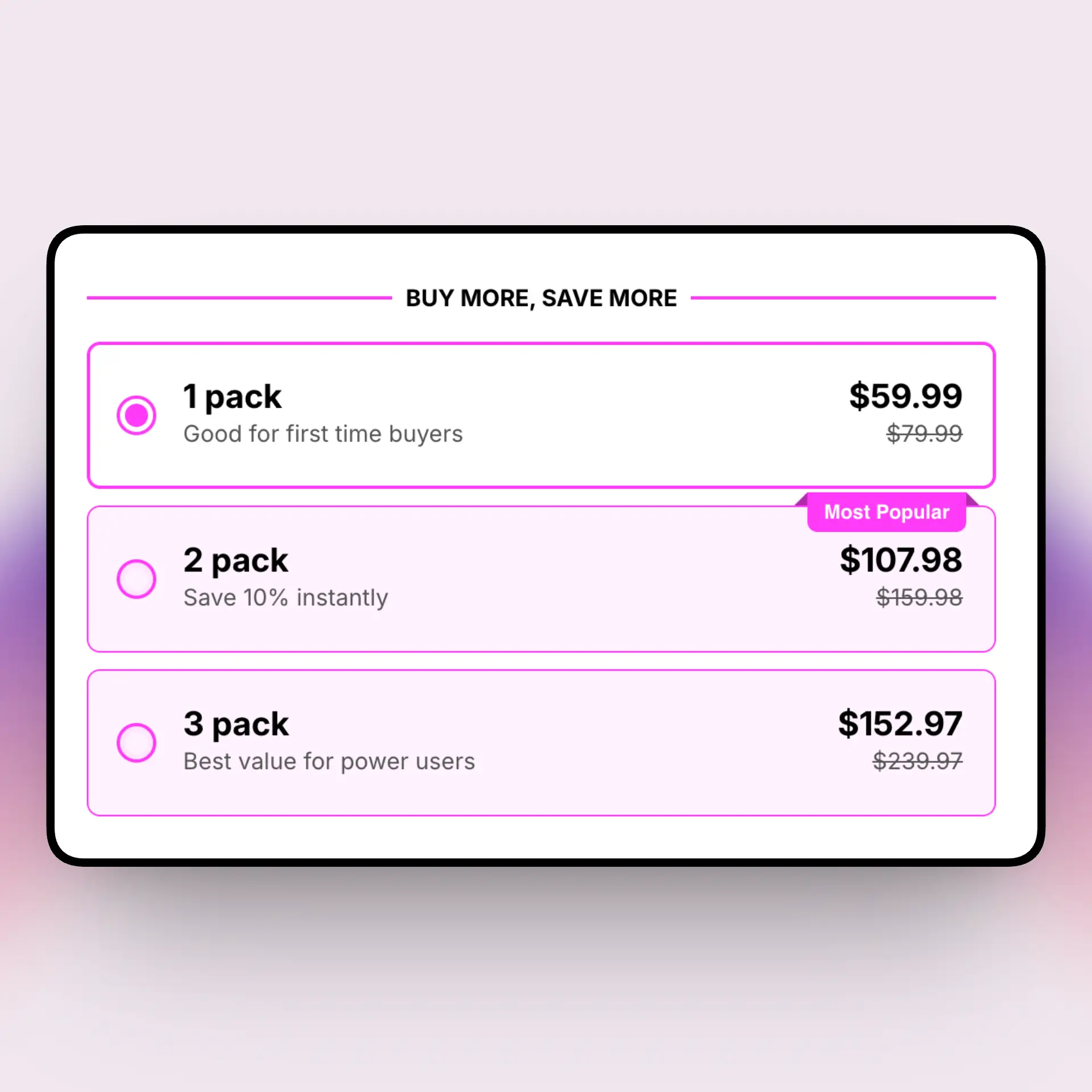
A quantity break (also called a volume discount, bulk discount, quantity discount, or tiered pricing — the buy-more-save-more model) drops the per-unit price when someone buys more of one product. Buy 1 candle for $20. Buy 2, save 10%. Buy 3, save 15%. That's quantity break pricing in one line.
A bundle groups different products into one deal. Shampoo, conditioner, and serum together for 15% off the combined price.
| Quantity Break | Bundle | |
|---|---|---|
| What it discounts | More units of the same product | Different products bought together |
| The shopper thinks | "I'll stock up, it's cheaper" | "This set solves my whole problem" |
| Best products | Consumables, refills, basics | Kits, routines, gift sets |
| Main goal | More units per order | More products per order |
| Profit math | One margin, easy to check | Blended margin across items |
| Setup effort | Low: one rule covers many SKUs | Higher: each set is designed |
Notice the second row. That's the real difference. A quantity break sells more of what the shopper already wanted. A bundle sells the rest of the solution.
Keep that line in your head and the rest of this guide is easy.
The One-Question Test
For every product in your store, ask:
"Would a happy customer want a second unit of this exact item?"
- Yes → quantity break. Coffee, socks, supplements, candles, dog treats, t-shirts.
- No, but they'd want a matching item → bundle. Cleanser pairs with moisturizer. A knife wants a sharpener.
- No, and nothing matches it → neither. Skip the discount. Some products sell best alone.
Run your ten best sellers through this test right now. It takes two minutes.
Most stores find a split: some products scream "stock up" and others scream "complete the set." That split is your discount strategy. You don't pick a winner. You assign each product its natural offer.
One honest warning. Nobody buys a second mattress for 15% off. If a product is one-and-done, a quantity break can't change behavior, so it can't pay for itself. We cover that trap in do quantity breaks hurt profit.
Six Signs Quantity Breaks Are Your Tool
Lean on quantity breaks when most of these sound like your store:
- People use your product up. Coffee, skincare refills, vitamins, pet food. Running out is built in, so buying ahead feels smart, not pushy.
- You sell one product, or a few. A single-product brand has nothing to bundle. Tiers are the whole AOV play. (If that's you, the bundle-only guide covers the moment that changes.)
- Your catalog is huge. One tier rule can cover 500 SKUs at once. Designing 500 bundles by hand is a part-time job.
- Buyers shop in multiples already. Check your average units per order. If it's near 2, a "buy 3" tier rides a habit that already exists.
- You sell to other businesses. B2B buyers expect per-unit prices to fall with volume. It's the oldest pricing pattern in trade.
- You want set-and-forget. Tiers don't go stale. A holiday gift bundle needs a January cleanup; "buy 3, save 15%" runs all year.
There's psychology working for you here too. Three tiers create an anchor: the middle option looks like the smart pick when a bigger tier sits above it. Researchers call this the decoy effect, and it's why three tiers usually beat two.
Ready to build? The setup guide walks through every method, and the pricing guide has ready-made tier ladders by margin.
Six Signs Bundles Are Your Tool
Lean on bundles when these fit:
- Your products complete each other. Cleanser, toner, moisturizer. Razor, blades, balm. The set solves the problem; the single item only starts it.
- Customers need guidance. A "complete starter kit" answers the scariest question a new buyer has: "What do I actually need?"
- You sell gifts. Nobody gifts one sock. Sets photograph better, wrap better, and carry a higher price without feeling expensive.
- You have hero products and shy ones. A bundle lets your best seller introduce a product nobody clicks on. The hero carries the shy one into the cart.
- You want a higher price point, not a discount fight. A $79 kit feels like value. The same items priced alone invite comparison shopping.
- Returns hurt you. In fashion, mix-and-match sets that let buyers pick sizes cut wrong-size returns. Our fashion bundle guide shows how.
Economists have studied this one for fifty years. Adams and Yellen (1976) showed why bundling captures value single pricing can't: different buyers value each item differently, and the bundle smooths that out. Shopify's own bundling guide reaches the same place in plain English: sets raise order value and move slow stock.
Niche playbooks, if you want them: beauty and skincare bundles, and bundling a large catalog without building sets one at a time.
The Profit Math, Side by Side
Both offers obey one rule: the discounted order must earn more profit dollars than one full-price sale. Percentages drop; dollars must rise. Here's each offer on real numbers.
Quantity break math (one margin, easy)
A $25 jar with a $10 true profit per unit (a 40% margin, after shipping, packing, and fees):
- One full-price sale: you keep $10.
- 3-pack at 15% off: each unit earns $6.25, so the order earns $18.75.
The order nearly doubles your profit. One check before launch: tier quantity > margin ÷ (margin − discount). The full walkthrough, plus a free calculator, lives in the break-even guide.
Bundle math (blended margin, watch closely)
Now a two-item set: a $20 shampoo with $8 true profit, and an $18 conditioner with $7 true profit.
- Combined price: $38. Combined profit at full price: $15.
- Bundle at 15% off: the discount costs $5.70, so the order earns $9.30.
- Versus the shampoo selling alone: $9.30 beats $8. The bundle wins, barely.
See how much thinner that win is? Two things did it:
- The discount applies to the whole set. A 15% bundle discount is a bigger dollar give than a 15% tier on one extra unit.
- Margins blend. The set's margin is the average of its items. Slip one low-margin product into a set and the blended margin can fall below your discount. That set loses money on every sale and looks "successful" the whole time.
The safety rule, for both offers
Keep your deepest discount at least 15 points below your true margin. For a quantity break that's the product's margin. For a bundle it's the blended margin of every item in the set. Compute it before you pick the percentage, not after.
One more honest note on bundles: if most buyers were already buying both items together, the bundle discount is a refund on sales you had. Check your order history first. The bundle should create the pairing, not reward it.
How to Run Both Without Confusing Shoppers
The answer to "which one?" is usually "both, in different places." Here's the clean way to do it.
Step 1: Map your catalog
Sort products into three buckets with the one-question test. A 50-product coffee brand might look like this:
| Bucket | Products | Offer |
|---|---|---|
| Repurchased weekly | Coffee bags, filters | Quantity breaks: 2 / 3 / 5 tiers |
| Used together | Starter gear: grinder + scale + bag | "First Setup" bundle at 12% off |
| One-and-done | The $400 espresso machine | No discount. Sell it straight. |
Step 2: One hero offer per product page
This is the rule stores break most. A page showing a tier table and a bundle widget and a BOGO badge reads like a flea market. Confused shoppers don't pick the best deal. They leave.
- Give every product page one featured offer.
- Cross-sell the other offer in cart, where it doesn't fight the buy button.
Step 3: Decide your stacking rules on purpose
Shopify only combines automatic discounts with codes when you allow it per discount. Decide now: does your welcome code stack on tier prices? A 10% code on top of a 25% tier is a 35% total give. If that's deeper than your margin, the stack quietly loses money on your best orders.
Step 4: Review in 30 days
Watch average order value, units per order, and profit per order. Tier doing nothing? Move it next to the buy button. Bundle doing nothing? The pairing may be wrong, not the price. The full testing playbook is in how to increase sales with quantity breaks.
What Shopify Gives You for Free (And Where It Stops)
Good news first: you don't need an app to test fixed sets. Shopify ships a free Shopify Bundles app that handles fixed bundles and multipacks with real-time inventory sync.
Where the free app stops:
- No tiered quantity discounts. The buy-more-save-more table on a product page isn't something the free app does.
- No mix-and-match by group. "Pick any 3 from this collection" needs more than fixed sets.
- No discount ladders or bundle analytics. You'll be guessing at what works.
So the honest pairing looks like this: Shopify's free app for a simple fixed set, and a dedicated app the moment you want tiers, mix-and-match, BOGO, or numbers you can act on. We compared the main options, with verified pricing, in the best quantity break apps guide and the volume discounts overview.
(Yes, Oxify is one of those apps. Oxify is $14.99/month after a 14-day free trial, with no revenue cap, rated 4.9★ — and it runs quantity breaks, bundles, BOGO, and free gifts from one place, which matters more than it sounds: one app means your offers can't fight each other at checkout.)
Seven Mistakes Stores Make When Choosing
- Treating it as either-or. The two offers aren't rivals. Assign each product its natural deal and run both.
- Quantity breaks on one-and-done products. No discount creates a need for a second mattress. The tier just sits there.
- Bundling two slow sellers. Two products nobody wants don't sum to one product people want. Every bundle needs a hero item.
- Ignoring blended margin. The most expensive bundle mistake. One thin-margin item in the set can flip the whole deal negative.
- Showing every offer on every page. One hero offer per page. Cross-sell the rest in cart.
- Copying a competitor's discount depth. Their margin isn't yours. Run your own numbers with the break-even calculator.
- Letting codes stack by accident. Check each discount's combination settings. Stacks should be a choice, not a surprise.
Frequently Asked Questions
What is the difference between a quantity break and a bundle?
A quantity break discounts more units of the same product: buy 2, save 10%; buy 3, save 15%. A bundle groups different products into one deal: shampoo plus conditioner plus serum for 15% off. Same product repeated means quantity break. Different products combined means bundle.
Which is better for increasing average order value: quantity breaks or bundles?
Neither wins everywhere. Quantity breaks lift AOV best on consumables and basics that people happily buy in multiples. Bundles lift AOV best when products are used together, like a routine or kit. Match the offer to how people use the product, and run both across different products.
Can I run quantity breaks and bundles at the same time?
Yes, and most stores should. The rule: one hero offer per product page. Put quantity breaks on products people repurchase, and bundles on products that complete each other. Don't show both offers on the same page, because a confused shopper picks neither.
Is a bundle the same as a BOGO deal?
No. BOGO (buy one, get one) is closer to a quantity break: it rewards buying more units, often of the same product. A bundle combines different products at one price. BOGO works well for clearing stock fast; bundles work better for raising the value of every order.
Do quantity breaks or bundles make more profit?
Both follow the same rule: the deal wins when the extra units earn more profit dollars than one full-price sale. Quantity breaks are easier to check because every unit has the same margin. Bundles blend margins across products, so run the math on the blended margin before you set the discount.
Does Shopify have built-in bundles or quantity breaks?
Shopify ships a free Shopify Bundles app for fixed bundles and multipacks. It doesn't do tiered quantity discounts, mix-and-match by group, or bundle analytics. For quantity breaks shown as buy-more-save-more tiers on the product page, you need a discount app or custom Shopify Functions code.
Should a one-product store use bundles or quantity breaks?
Quantity breaks, almost always. With one product there's nothing to bundle with, but there's plenty to multiply. A 2-pack and 3-pack tier turns single sales into bigger orders. If you later add an accessory or refill, test a small bundle next to the tiers.
What discount should I use for a bundle vs a quantity break?
Common retail ranges: 5% to 20% for quantity break tiers, and 10% to 20% off the combined price for bundles. Whatever you pick, keep the deepest discount at least 15 points below your true margin. For bundles, use the blended margin of every item in the set.
Why do stores sell some products only in bundles?
That's called pure bundling: the set is the only way to buy. It raises perceived value and simplifies choice, and it works for routine-based brands like skincare. Most stores do better with mixed bundling, where shoppers can buy items alone or save in the set.
Do quantity breaks and bundles work with discount codes?
Usually yes, but it depends on your setup. Shopify lets automatic discounts combine with codes only when you allow it in each discount's combination settings. Decide on purpose: stacking a welcome code on top of a deep tier can quietly push the total discount past your margin.
Sources & Further Reading
- Shopify: Product Bundling for Retail — why sets raise order value and move slow stock
- Shopify: Average Order Value (AOV) — the metric both offers move first
- Shopify Help Center: Shopify Bundles App — what the free first-party app covers
- Adams & Yellen (1976): Commodity Bundling — the economics of pure vs. mixed bundling
- The Decision Lab: The Decoy Effect — why three tiers beat two
- What Are Quantity Breaks? — the plain-English basics
- Do Quantity Breaks Hurt Profit? — the break-even formula and free calculator
- How to Set Up Quantity Breaks on Shopify — step-by-step setup
- Should Your DTC Brand Sell Only Bundles? — the pure-bundling play
- Bundling a Large Catalog — sets at scale without extra SKUs
- Oxify Bundles Quantity Breaks — on the Shopify App Store