Oxify vs Pareto — Shopify Quantity Breaks for DTC vs B2B
Both apps do quantity breaks well, but they aim at different stores. Pareto is the B2B and wholesale specialist, with customer-tag and market-based pricing. Oxify is the all-in-one DTC app for growing average order value, with a broad bundle toolkit in one flat $14.99/month plan. Here's an honest, side-by-side look so you pick the right one.
Built for Shopify · 4.9 ★ rating · $14.99/mo after a 14-day free trial · 1-click install
- Quantity breaks
- Mix & Match bundles
- BOGO offers
- Free gifts
- Subscriptions
- A/B testing
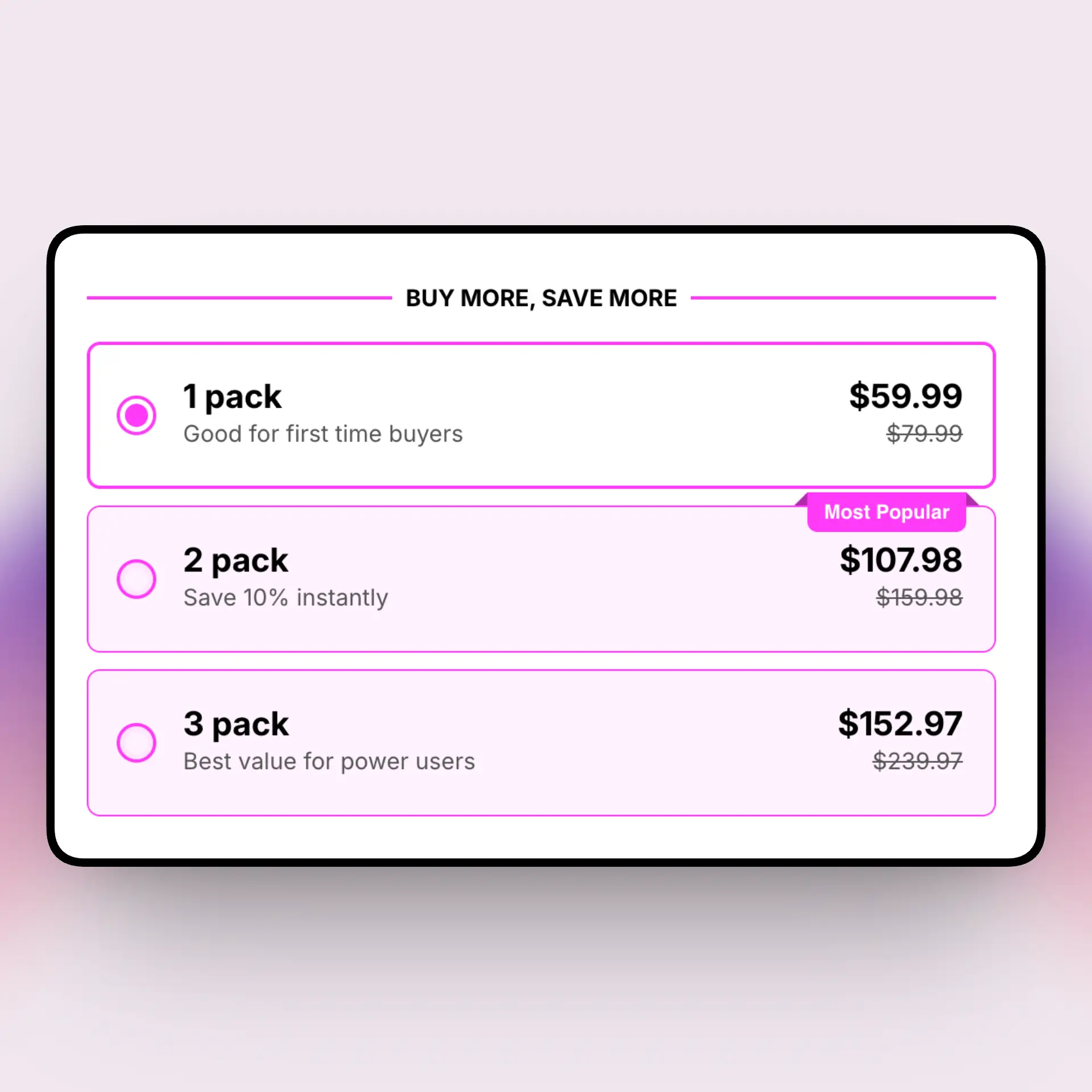
Quantity breaks plus mix & match, BOGO, free gifts, and subscriptions in one app.
Customer-tag and market pricing, discount stacking, bulk tools, and POS support.
Oxify vs Pareto in one minute
There's no single winner here. The right app depends on who you sell to. Both are rated around 4.8–4.9 stars and both run quantity breaks. The real difference is focus. One app was built to price by customer. The other was built to grow the size of each cart. So the smart question isn't "which is best?" It's "which one matches my store?"
Pareto wins for B2B and wholesale. It's built for stores that price by customer. You get customer-tag pricing, market-based rules, scheduled discount campaigns, discount stacking, bulk export, store-to-store migration, and Shopify POS support, plus 24/7 live chat with onboarding. If you run a wholesale or enterprise catalog where a trade buyer should see one price and a retail shopper another, that toolkit is hard to match. It also has 230+ reviews, which is a lot of merchants leaning on it for serious pricing rules.
Oxify wins for DTC average order value. It's built to make each cart bigger on a consumer storefront. You get quantity breaks plus mix & match, Build Your Own Box, BOGO, free gifts, and subscription pricing in a single install, with A/B testing included in one $14.99/month plan — no higher tier to unlock. Instead of pricing by who's buying, Oxify nudges every shopper to add one more unit, one more product, or a repeat order. That's the lever that lifts AOV on a DTC store.
Short version: pick Pareto if your edge is wholesale pricing rules. Pick Oxify for quantity breaks and a broad set of AOV-boosting bundles on a DTC store. Many merchants never have to choose between the two, because their business model points clearly at one or the other.
Bottom line: Oxify is the DTC-focused alternative to Pareto — a flat $14.99/month (or $129.99/year) against Pareto's paid plans from $19.99/month — with quantity price breaks, tiered pricing, BOGO, Build Your Own Box, and free gifts included. Pareto remains the stronger volume discount app for B2B and wholesale pricing rules, and its limited free tier is worth a look if you need $0. Last updated .
Oxify vs Pareto — feature comparison
Here's the head-to-head at a glance. The numbers and features below are honest on purpose. Pareto and Oxify share a lot of ground on the core discount types, so the rows that matter most are at the top (ratings, plans, price) and the bottom (the B2B and subscription rows where they part ways).
| Feature | Oxify | Pareto |
|---|---|---|
| Rating | 4.9 ★ | 4.8 ★ |
| Reviews | 13 | 230+ |
| Free plan | No — 14-day free trial | Yes (limited) |
| Starting paid price | $14.99/mo ($129.99/yr), every feature | $19.99/mo |
| Quantity breaks | Yes | Yes |
| Mix & match bundles | Yes — plus Build Your Own Box | Yes |
| BOGO / Buy X Get Y | Yes | Yes |
| Subscriptions | Yes | Not a focus |
| A/B testing | Yes | Not a focus |
| B2B / wholesale pricing (tags & markets) | Not a focus (built for DTC AOV) | Yes — customer-tag & market-based rules, discount stacking |
Want the full field? See our Shopify quantity breaks app comparison or the deep-dive on Oxify vs Quantity Breaks & Discounts, the best quantity break apps for Shopify.
Choose Pareto if…
Pareto's real edge is B2B and wholesale tooling. If pricing changes by who's buying, this is your app. Most DTC apps can't handle that, because they treat every visitor the same. Pareto doesn't. Pareto is the better fit when:
- You sell B2B or wholesale. Pareto is built for it, with enterprise-ready pricing rules.
- You need customer-tag pricing. Show different prices to retail, trade, or VIP groups using customer tags.
- You price by market. Set market-based rules so different regions or storefronts see the right pricing.
- You stack discounts. Pareto supports discount stacking and scheduled discount campaigns.
- You need bulk tools. Bulk export and store-to-store migration help with large catalogs.
- You sell in person too. Pareto supports Shopify POS, with 24/7 live chat and onboarding.
Here's the fair part: Pareto also does quantity breaks, volume discounts, bundles, and BOGO, so you don't give those up by going B2B-first. It isn't a stripped-down wholesale tool that forgot about discounts. It's a full discount app with a wholesale brain on top. If your store mixes retail and trade buyers, that combination can save you from running two apps. You can find Pareto on the Shopify App Store.
Choose Oxify if…
Oxify is built for DTC stores that want bigger carts. It packs a broad bundle toolkit into one install, so you're not stitching together three apps to run quantity breaks, bundles, and gifts. Oxify is the better fit when:
- You sell DTC and want higher AOV. Oxify is focused on average order value, not wholesale pricing.
- You want everything in one app. Quantity breaks, mix & match, Build Your Own Box, BOGO, free gifts, and subscriptions all live in a single install.
- You want to test offers. Built-in A/B testing helps you find the tiers and bundles that convert.
- You want one predictable price. The whole app is $14.99/month with no revenue cap — no higher tier to grow into.
- You're comparing paid plans. Oxify starts at $14.99/month ($129.99/year) vs Pareto's paid plans from $19.99/month.
- You want extras that nudge AOV. Free shipping triggers, cart progress bars, and built-in analytics come baked in.
Because all of this lives in one app, you set up a quantity break, add a free-gift threshold, and turn on a subscription option without leaving Oxify. The widgets render on the product page and in the cart, so shoppers see the savings before they decide. And since Oxify carries Shopify's Built for Shopify badge, it meets Shopify's highest bar for speed, design, and clean integration.
See it in action on the Oxify demo store, or learn how volume discounts on Shopify lift AOV. Weighing other tools? Check Oxify vs Kaching too, or read our guide to the best quantity break apps over on the blog.
Oxify vs Pareto — quick answers
Is Pareto or Oxify better for quantity breaks?
Both do quantity breaks well. Pareto is stronger for B2B and wholesale, with customer-tag pricing and discount stacking. Oxify is stronger for DTC stores that want quantity breaks plus mix and match, BOGO, free gifts, and subscriptions in one $14.99/month plan.
What is the best Pareto alternative for DTC stores?
Oxify is a strong Pareto alternative for DTC. It focuses on average order value with a broad bundle toolkit, including quantity breaks, mix and match, Build Your Own Box, BOGO, and free gifts — all in one $14.99/mo plan, with a 14-day free trial.
Does Oxify support B2B and wholesale pricing?
Oxify is built for DTC AOV, not B2B. If you need customer-tag pricing, market-based rules, discount stacking, bulk export, or Shopify POS support, Pareto is the better fit.
Does Oxify or Pareto have a free plan?
Pareto does: a limited free tier, with paid plans from $19.99/mo above it. Oxify does not; it offers a 14-day free trial, then one $14.99/month plan with every feature and no revenue cap. If $0 is a hard requirement, Pareto's free tier is the one to try.
How much does Oxify cost compared to Pareto?
Oxify is $14.99/month (or $129.99/year) for the complete app, at any revenue, after a 14-day free trial. Pareto has a limited free tier with paid plans from $19.99/mo. On paid plans Oxify starts lower; the real question is whether you need Pareto's B2B-specific features.
Can I switch from Pareto to Oxify?
Yes. Oxify installs in one click from the Shopify App Store and adds its bundle widgets without theme edits, so you can test it alongside Pareto during the 14-day free trial before deciding.
Try Oxify for 14 days: quantity breaks with mix & match, BOGO, and more.
Quantity breaks, mix-and-match bundles, free gifts, subscriptions, and A/B testing in one $14.99/month plan. Start with a 14-day free trial.
Selling B2B or wholesale? Pareto's listing may suit you better.